
Learn Languages by Reading Literature
Part two
Learn languages by reading literature. In case you missed it, you can read about the first five reasons why reading is one of the best ways to learn a language in Part One of this blog post.
6. CULTURAL LENS
A cultural lens is the way one looks at the world. Behind a language, there is a unique lens of the world. The way we write, talk, and express ourselves is influenced by the culture we were born into. (Balboni & Caon, 2015).
Reading books helps to understand cultural differences and similarities, and to communicate more effectively.
7. KNOW YOURSELF
Reading in a foreign language helps to get to know yourself and to better express yourself. Learning a foreign language means not only using that language as a tool to do something but also as a tool to be someone.

Reading makes us live thousands of lives we could have thought of, identifying ourselves in plots and characters. Language learners need to lose and immerse themselves in native speakers’ thoughts, dreams, aspirations, and feelings in order to finally find the right words to describe their own thoughts, dreams, and feelings.
Literary texts stimulate the imagination of our students, to develop their critical abilities, and to increase their emotional awareness. (Lazar, 1993)
8. IMPROVEMENT
The more you read, the more you will improve all other language skills: you will write and speak better, and have better control of grammar and spelling (Krashen, 2004).
Remember: for language learners, communication is the key.
Reading is useful in enhancing all your skills and confidence in your targeted language. Studies prove that free voluntary reading
“is one of the best things a second language acquirer can do to bridge the gap from the beginning level to truly advanced levels”. (Krashen, 2004)

We often forget that when we learn a language, all skills are inter-connected. Improvement in one skill impacts all others. This translates into becoming more comfortable with vocabulary, control of grammar, writing style, spelling, and being able to reuse them correctly and speak more articulately.
9. MEMORY
When you learn a language, one of the biggest challenges is to memorise new words. The more you are exposed to words in a meaningful context, the more you will remember them. Reading is one of the best ways to memorise a large amount of new vocabulary.
We memorise more by reflecting on a subject, by reading about it, working on it, and reusing it. You want to understand the new words to be able to go on with your reading and understand the plot.
10. REVIEW GRAMMAR
Reading a book is the perfect way to review grammar rules that you struggle to understand and practice. You will understand better how and when to use certain structures and verbs. You will see them in context, understand them as a rule and reuse them.
Neurolinguistic theories affirm that we learn better starting from the context to the “rule”, respecting our brain’s language acquisition process (Balboni, 2018).
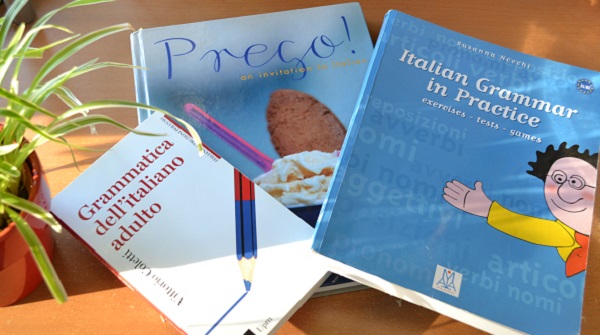
As Krashen reported in his study on the power of reading, many language learners who embraced free voluntary reading performed better in grammar tests compared to students who were not exposed to free voluntary reading (Krashen, 2004).
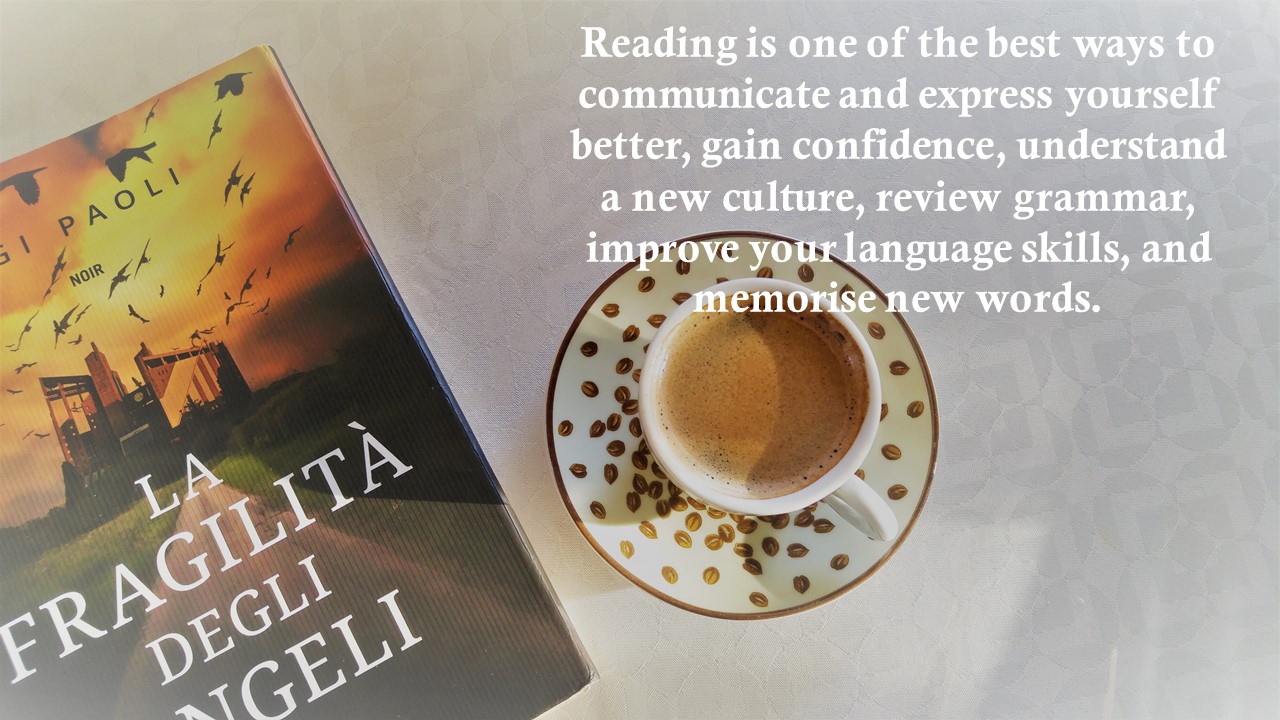
To summarize, reading is one of the best ways: to communicate and better express yourself, gain confidence, understand a new culture, review grammar, improve your language skills, and memorise new words.
References
Balboni, P. (2001). La torre di Babele. Torino: Utet.
Balboni, P. (2018). Fare educazione linguistica. Insegnare italiano, lingue straniere e classiche. Novara: UTET Università.
Balboni, P., & Caon, F. (2015). La comunicazione interculturale. Venezia: Marsilio.
Bernardini, V. (2017, Febbraio). Il testo letterario per l’apprendimento dell’italiano come lingua straniera o seconda. Bollettino Itals, 67.
Celentin, P., & Beraldo, R. (n.d.). Letteratura e didattica dell’italiano LS. Laboratorio Itals. Retrieved from https://www.itals.it/sites/default/files/Filim_letteratura_didattica_italiano_ls.pdf
Krashen, S. (April 2004). Free Voluntary reading: New research, Applications, and Controversies. Singapore: RELC conference. Retrieved from http://www.sdkrashen.com/content/articles/singapore.pdf
Krashen, S. D. (2004). The Power of Reading: Insights from the Research. Westport, Conn: Libraries Unlimited.
Krashen, S., & Terrell, T. (1983). The Natural Approach: Language Acquisition in the Classroom. Hayward, Calif: Alemany Press. Retrieved from http://www.sdkrashen.com/content/books/the_natural_approach.pdf
Lahiri, J. ( 2015, November 30). Teach yourself Italian. The New Yorker. Retrieved from https://www.newyorker.com/magazine/2015/12/07/teach-yourself-italian
Lahiri, J. (2019, September 10). Jhumpa Lahiri on Editing an Anthology of Italian FIction. Lithub. Retrieved from https://lithub.com/jhumpa-lahiri-on-editing-an-anthology-of-italian-fiction/
Lazar, G. (1993). Literature and Language Teaching. A Guide for Teachers and Trainers. Cambridge: Cambridge University Press.
Lewis, M. (1993). The Lexical Approach: The State of ELT and a Way Forward. University of Michigan: Language Teaching Publications.
Torresan, P. (2011, Novembre). Apprendere con la letteratura. Intervista a Elisabetta Santoro. Officina.it, 18. Retrieved from https://www.almaedizioni.it/it/officina/2011/officina-16/